

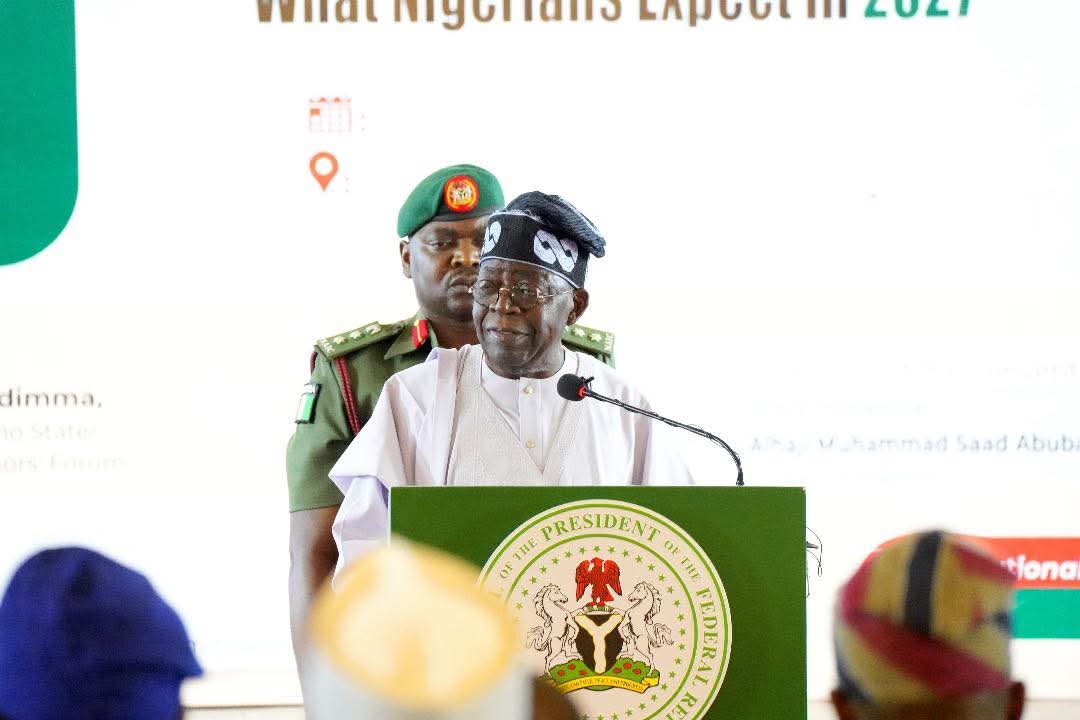
President Bola Ahmed Tinubu on Friday presented the 2026 Appropriation Bill, totalling ₦58.18 trillion, to a joint session of the National Assembly, describing it as a “Budget of Consolidation, Renewed Resilience and Shared Prosperity.”
Delivering the budget speech in Abuja, the President said the proposal builds on reforms undertaken over the past two and a half years to stabilise the economy, restore confidence and lay the foundation for inclusive growth. He acknowledged that the reforms had imposed hardships on citizens and businesses but assured Nigerians that the sacrifices were yielding results.
Tinubu cited key economic improvements, including 3.98 per cent GDP growth in the third quarter of 2025, moderation in inflation to 14.45 per cent in November 2025, improved oil production, higher non-oil revenue, rising investor confidence and external reserves at a seven-year high of about $47 billion.
According to the President, projected total revenue for 2026 stands at ₦34.33 trillion, while total expenditure is estimated at ₦58.18 trillion, including ₦15.52 trillion for debt servicing. Capital expenditure is put at ₦26.08 trillion, recurrent non-debt spending at ₦15.25 trillion, and the fiscal deficit at ₦23.85 trillion, representing 4.28 per cent of GDP.
He said the budget is anchored on a crude oil benchmark of $64.85 per barrel, daily production of 1.84 million barrels and an exchange rate of ₦1,400 to the dollar.
The President outlined four key objectives for the 2026 fiscal year: consolidating macroeconomic stability, improving the business environment, promoting job-rich growth and reducing poverty, and strengthening human capital development while protecting vulnerable groups.
Major sectoral allocations include ₦5.41 trillion for defence and security, ₦3.56 trillion for infrastructure, ₦3.52 trillion for education and ₦2.48 trillion for health. Tinubu said national security remains the foundation of development, adding that the government would adopt a new counterterrorism doctrine and treat all armed non-state actors as terrorists.
In education and health, the President highlighted expanded access to student loans, support for over 788,000 students nationwide and increased healthcare funding, alongside anticipated international support exceeding $500 million for health interventions.
He also announced continued investment in agriculture, mechanisation and agro-value chains to enhance food security, create jobs and boost exports, as well as ongoing procurement reforms and the implementation of a “Nigeria First Policy” to prioritise locally made goods.
Tinubu assured lawmakers that 2026 would mark stronger discipline in budget implementation, with strict adherence to timelines, improved revenue mobilisation, enhanced accountability and better monitoring of government spending.
He urged the National Assembly to partner with the Executive in delivering the Renewed Hope Agenda, stating that the success of the budget would be measured not by its announcement but by its effective implementation.
The President formally laid the 2026 Appropriation Bill before the National Assembly for consideration.